











 About Us
 Brand
Brand
 Career
 Contact Us



 +91-7314623098






A recent SHRM study found that employees’ financial health will be a huge priority for employers in 2024 and beyond. Employees want to be taken care of holistically, especially in a volatile, unpredictable economy such as the one we’re living in. This includes making sure they’re financially safe and stable.
Each employee is a substantial human investment. Knowledge-based organizations must invest in their people if it is to exist. This investment in people improves and adds value to people. Employee Benefits, although cost the organization heavily, primarily serve to retain employees. They’re programs an employer uses to supplement the cash compensation, which may include social insurance, group insurance, vacation, paid time off, financial support for caring for dependents, etc.
In this article, we’ll take you through employee benefits that are trending and used by organizations across the world, so you can choose the ones you want to include in your current plan and implement them.
What are Employee Benefits?
Employee benefits are non-wage components added to the basic salary structures for members of the workforce. Strategically architected, benefits become an enterprise lever that drives organisational resilience, signals systemic care and directly shapes workforce productivity. This is a world away from the compliance-driven perks of yesteryear.
Why Are Employee Benefits Important?
Amazing for attracting A-list talent
A combination of direct compensation (pay) and benefits represents total compensation. The best way to attract potential employees is by offering competitive benefits that show them you care about them as a person, and not just a professional. It can also retain solid performers and show them as they grow with the company, they will be adequately taken care of. In a talent crisis, employees expect progressive, compassionate, and competitive benefits, and being upfront about it will help you attract A-list talent.
That’s why many fast-growing companies have a benefits and rewards sheet that they give to employees during and after the hiring process, to show what they can get should they come to work with them.
Keep existing employees motivated
For existing employees, benefits over and above salary will be a huge motivating factor, as the employer will take care of crucial expenses for every life stage. It’ll also help employees stay aligned with the organizational goals. If you’re working on building a company from scratch and one of the core team members just became a father, they’d appreciate joining your team if they get childcare benefits and occasional time off to tend to family. You’d get exceptional talent if you go the extra mile and bring in inclusive measures that they need the most.
Encourages positive behavior
Further, employee benefits are great for encouraging behavior that is conducive to the organization. If a team member goes above and beyond to get cross-functional projects done, coordinates with cross-cultural teams, or takes the initiative to train junior employees all by themselves, they deserve to be rewarded. The best way to reward them is to take a major expense off their shoulder by introducing the right benefits.
With regard to employees, having benefit programs maximize the value of the benefits received, and minimize out-of-pocket expenses. It makes for better cash flow for employees and acts as a supplement to their current income. Employees also develop a sense of commitment towards the organization that takes care of them, which further fuels employee productivity, and eventually boosts organizational image.
Promote Workplace Inclusion
An inclusive workplace isn’t about posters; it’s about policies. Companies that provide benefits for different life stages, such as maternity support, flexible hours for carers or insurance for dependents, send a powerful message. We make every employee feel they belong, regardless of background or circumstance. Inclusion is lived experience, not just intention.
Improve Employee Retention
High performers are often lost not over pennies on a pay cheque, but over a lack of empathy in benefits. In a medical emergency or a family milestone, employees feel supported, and their loyalty grows deeper. Attrition is costly to ignore and surprisingly cost-effective to achieve when an organisation truly invests in the well-being of its people.
Types of Employee Benefits
As a thumb rule, it’s advised to have 20-40% of the total compensation package dedicated to employee benefits. The value of benefits, even those with clear price tags, actually will vary from individual to individual depending on the actual use. Additionally, you can choose to give some benefits to an exclusive group of employees, based on their experience, caliber, or department.
Additionally, benefits are becoming hyper-personalized, according to life stages, and companies are required to get in touch with who their workforce really is to craft benefits for them.
Tina Wang, Divisional Vice President- Human Resources at a reputed management consulting firm says in an interview with NASDAQ, “Companies who understand how total compensation package expectations have changed are able to attract and retain their workforce. In 2024 we saw career progression take the front seat when it comes to employee benefits, followed by flexibility, and skill development.”
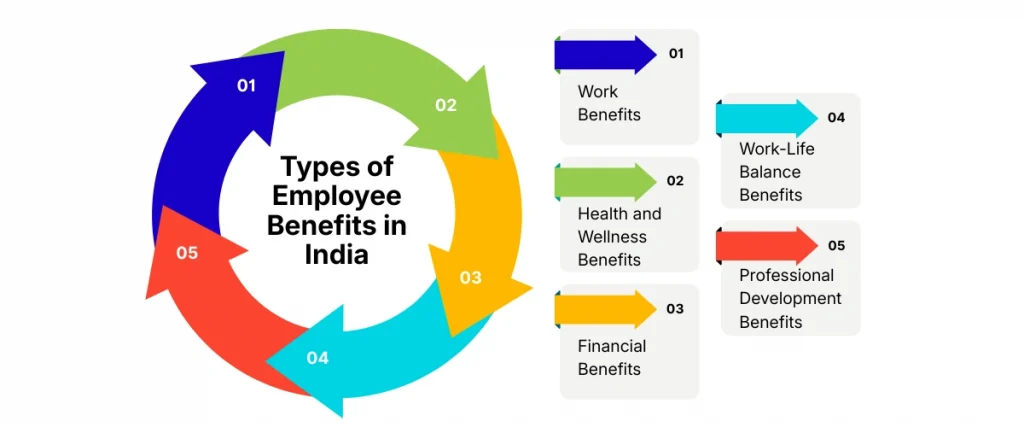
Work Benefits
These are the day-to-day enablers that respect an employee’s time and humanity at work.
Flexible Working Hours
Rigid 9-to-5 structures belong to a bygone era, especially for knowledge workers. Flexibility acknowledges that a senior manager might be a parent, or a developer might be a night owl. Trusting people with their time yields dividends in output and mutual respect.
Food and Meal Benefits
Never underestimate the power of a shared meal or a subsidised cafeteria. It removes a daily logistical burden and fosters organic collaboration. It’s a small human touch that builds a large community feel.
Gifts and activities
Celebrating milestones, such as birthdays, work anniversaries, and festival tokens, humanises the workplace. It tells employees they are seen as individuals with lives, not just resources to be deployed.
Health and Wellness Benefits
Non-work behaviors and personal problems can adversely affect an employee’s work.
Health insurance
Depending on the gender, age, and background, you may need to select a few options to cover most health risks for themselves and their families. You can also choose reimbursement options that are tax-free and is a great way to scale if you have fluctuations in the workforce.
Gym membership
This is a benefit you need to consider how to administer. You could do a reimbursement model if that works for you. This is an essential benefit to help employees avoid medical bills, but if people don’t want to use the gym, their membership will only go to waste. Instead, try a model that reimburses the fees of employees who actively use the gym.
Options to sponsor IV fertilization
This is a treatment that’s becoming increasingly popular and opted for by many couples worldwide, and it comes with a hefty bill. If you stand with your employees in their vulnerable moments, and help them through this tense period, they’ll remember it forever, and stay loyal to your organization, and the values you stand for. Consider including it in your health plan, if your policies allow it.
Menopause care benefits
Think about the category of women in your workforce between 44 and 55 years which may make up to 10% of your workforce. They face a multitude of health issues during this transition. Added to it, they manage mounting responsibilities at home and work, owing to their important role in both. All this definitely takes a toll on their body and mind, and they could use a lot of healthcare benefits, flexibility to make their schedule, and options to telecommute with short notice.
Urgent care claim benefit
These are claims for medical care or treatment that could seriously jeopardize the life or health of the claimant and could not be managed without proper care. This is one of the moments that matter for your employees, and they need to be able to access the claim as and when they need it, without having to go through a million procedures and wait for long. Time and accuracy are of the essence when it comes to urgent care claim benefits.
Mental health care
This benefit has always been important and has been given to employees on varying scales and capabilities. It has become more prominent and its value realized by many since the pandemic. 24/7 helpline can be a lifesaver for your employees, and their loved ones. Proactive mental healthcare is on the rise right now, which includes stress management workshops, focus group sessions, expert-led events, 1:1 counseling, peer support networks, etc all of which are essential components to be certainly included in your EAP. Choose a holistic wellbeing partner who offers these proactive services along with reactive services, to safeguard your employees’ mental wellbeing.
Financial Benefits
Financial stress is the silent killer of workplace productivity. Smart enterprises mitigate this through targeted support.
Profit-sharing benefits
Sharing profits with your employees keeps them engaged, and shows you care about their growth since it has a direct impact on your earnings. Set rules early on and make them clear upfront. Develop a program that works for your business and a structure that stays true to it. Remind employees that profit isn’t the only goal, you need to ensure desirable behavior to achieve profits, and that’s what counts. Give people a stake in the outcome, celebrate every milestone, and revisit your structure regularly. Educate your employees on what’s possible and what’s not. Open your books, and show them what’s what, so they can set reasonable expectations.
Employee stock option plans
Shares represent an ownership stake in a company, whereas option represents a right to purchase shares in the company at a later date for a below-market price. It gives accountability and promotes long-term thinking and deep loyalty. If the employees are fired for cause, or leave the organization, they forfeit the stock option.
Retirement benefits
These are benefits an individual collects after retirement, so they are allowed to keep receiving paychecks even after they stop working. You can choose to pay a fixed monthly income over an individual’s lifetime or a lump sum payment. Your employees are also promised a pension amount based on age and years of experience in the company – seperate from the private pension they may have contributed to privately. Choose a combination of an employer, and employee plan where both parties make an annual payment before retiring.
Insurance
Beyond statutory covers, comprehensive health and term insurance for employees and their families is the bedrock of financial security. It remains the single most valued voluntary benefit in the Indian context.
Work-Life Balance Benefits
Caregiving Benefits
If you have employees moving on-site from their hometown and have a baby and a working spouse, you may introduce on-site childcare benefits every month, for children up to a certain age, which will certainly help meet the additional costs of relocating to a different place. The provision of family-friendly options positively impacts employee satisfaction and organizational results, in turn.
Housing Subsidies
Likewise, taking care of relocation expenses can be a huge game-changer for employees who are moving away from home. Depending on the place they’re relocating to, the standard of living there, and the designation the person is in, their relocation fee and housing subsidy can be immensely helpful to them, and they’re likely to stay longer on the job.
Adoption benefits
Most medical benefit plans provide maternity coverage, however, if you care about motherhood regardless of the form it takes, be it surrogacy, or adoption, it’s appropriate to provide some reimbursement to employees who choose to become parents through non-conventional methods as well.
Transport allowances & cab services
Safety and commute ease, particularly for employees working late, is both a statutory sensibility and a moral imperative. It’s also a practical way to ensure punctuality and reduce daily fatigue.
Company retreats & team outings
These are not “junkets”; they are intentional investments in team cohesion. Stepping away from the desk resets dynamics and builds trust among senior and junior cohorts alike.
Professional Development Benefits
Tuition reimbursement and educational leave are two means of encouraging employees to add to their knowledge and skills. Every progressive organization wants its employees to be ready to face the future and make the organization resilient to any changes that may befall. Organizations are also investing in life and performance coaches for their employees, so they can achieve their potential in work and life.
High-potential employees leave when they stop growing. Development benefits are how enterprises keep them engaged and future-ready.
| Generation | Type of benefits most relevant to them |
| Boomer | Pre-retirement plansHealthcareOffboarding (from a career perspective) |
| Gen X | EldercareFamily benefits and self-care benefits |
| Gen Y | Flexibility and autonomy |
| Millennials and Gen Z | Energizing work Mental health benefitsFamily, people, and planet-related benefitsCareer development benefits |
Career Development Programs
Structured pathways showing employees “what’s next” reduce anxiety and boost engagement. It shows an organisation is invested in their long-term trajectory, not just quarterly targets.
Leadership Training
Mid-level managers require consistent development. Investing in leadership labs ensures succession planning is organic, not chaotic.
Certification and Education Support
Supporting further education or certifications signals respect for employee ambition. It also keeps an enterprise skill-forward in a disruptive market.
Statutory employee benefits in India
Compliance is non-negotiable. Ignoring statutory benefits isn’t just illegal; it’s reputationally fatal for any enterprise.
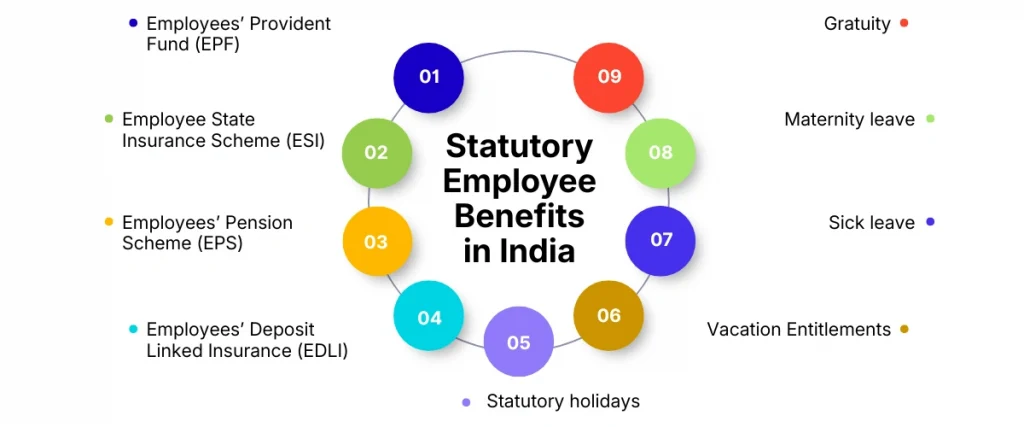
Employees’ Provident Fund (EPF)
A retirement savings mechanism where both employer and employee contribute 12% of basic wages, ensuring long-term financial dignity post-retirement.
Employee State Insurance Scheme (ESI)
For employees earning below a specified threshold, ESI provides medical and sickness benefits, funded jointly. It’s a critical safety net for the junior workforce.
Employees’ Pension Scheme (EPS)
Running parallel to EPF, EPS ensures a monthly pension post-retirement, offering stability to the aging workforce.
Employees’ Deposit Linked Insurance (EDLI)
An often-overlooked life cover linked to the provident fund, providing nominal insurance to the nominee in case of an employee’s untimely demise.
Statutory holidays
Mandated regional and national holidays respecting the diverse cultural fabric of India. Ignoring these is ignoring local identity and employee heritage.
Vacation entitlements
Earned leave accrued over service periods, vital for mental decompression. Leadership must encourage, not penalize, its usage.
Sick leave
Paid leaves for illness, ensuring employees don’t come to work compromised or fearful of lost wages when unwell.
Maternity leave
26 weeks of paid leave for new mothers, plus adoption and commissioning mother provisions. A true test of an organization’s empathy and gender-equity stance.
Gratuity
A lump-sum payment for employees completing 5+ years, acknowledging long-term service. It’s a statutory thank-you note for loyalty.
Best Practices for Your Employee Benefits Program
1. Evaluate who you are and what you want as a culture in your company
What are your values and what benefit programs are congruent with these values? Do a healthy introspection, and first arrive at the causes, values you care about, what your workforce cares about, and match benefits that take care of such causes. Depending on the compensation strategy, employers will have to decide on whether to lead the market by offering above-the-market benefits, lag by offering only traditional benefits, or match what the market offers.
2. Implement an organization-wide listening strategy
Use employee task forces, or focus groups to review ideas and express opinions. Ask your people and listen, truly. Some people can be overinsured but undersaved. Make sure you help them move from one stage to another by listening to them via employee engagement surveys, 1:1 conversations, exit interviews, stay interviews, and at all crucial employee lifecycle moments. Also ensure complete confidentiality in any data collection, so that employees feel free to come up with exactly what they want. Large organizations have large teams to take care of benefits. But, for smaller teams, it’s easier to bring people together and get the pulse of the company, and what’s important for you. It’s easier to experiment and continuously iterate with a smaller workforce.
3. Consult with a benefits partner
The benefits partner takes care of administering a whole bunch of benefits to a wide workforce and has access to not only industry data, but also the utilization, and impact data of a wide segment of employees. They’re the best people to guide you on what benefits appeal the most to your teams and that won’t break your bank.
4. Personalize the way, means, and type of messaging you use to communicate benefits
Assess what your current communication methods are and rule out the ones employees feel aren’t conducive to them. Take a look at what means you use to inform and later update each employee on the benefits they can choose from (print copy during onboarding, a thoughtful, yearly email campaign, physical, in-person workshops, etc). Do you use text messaging to send regular reminders and follow-ups? Assess what you are doing that’s effective, what to improve, and how can you insert yourselves in the right way.
Communication, enrollment, and technology need to work together for a seamless experience. Choose communication methods and platforms that resonate the most with employees, and their families in a way that is impactful and resonates and makes people realize the choices they have.
Ensure you have an omnichannel presence – print materials (during onboarding), text messages, email campaigns, digital assets, a thorough and constantly evolving benefits guide, and chatbots. Tailor the messaging to employees based on the packages they’ve chosen, their generation, and the life stage they’re in.
Conclusion
As employee benefit needs evolve, organizations are moving to a mature ecosystem of benefits tech providers, where they’re open to welcoming point solutions, and complete HCM suites, to ease the workload and bring all information into one system. Is your HR tech stack and ecosystem modern enough to allow these modern point solutions? If not, it’s time to make a change.
FAQ’s About Employee Benefits
What benefits do employees value most?
Across industries, health insurance for family and flexible work top the list. The younger workforce values development; the mature workforce values financial security. The common thread is always ‘security and respect’.
Do employee benefits really matter?
Yes. In a candidate-driven market, benefits are a differentiator. They impact employer brand, productivity, and attrition, all of which hit the P&L directly.
Can you offer different benefits to different employees?
Yes, and it is advisable. Tiering benefits based on life stages, roles, or levels, while keeping core statutory benefits equal, is smart segmentation, not discrimination.
What are real examples of strong employee benefits programs?
Companies giving sabbatical leaves after 5 years, mental health services, or 100% funding of certifications are some examples. These are not just benefits; these are care ecosystems that show true partnership with the employee.
What is the difference between employee benefits and compensation?
Compensation is the agreed price for labour (salary, bonuses). Benefits are the supportive wraparound, health, time, growth, that enhances the quality of that labour and the employee’s life.
Are employee benefits legally required in India?
Yes. EPF, ESI, Maternity, and Gratuity are legally required for organisations operating in India. However, voluntary ones are not mandated, but skipping them puts an enterprise at a severe talent disadvantage in today’s market.
What does employee benefits insurance coverage include?
Typically: health (inpatient/outpatient), accidental death/disability, term life, and sometimes critical illness. For Indian firms today, covering parents, spouse, and children is now table-stakes, not a luxury.